
What Are the Different Drive Mechanisms Used in Motorized Linear Stages?
What Are the Different Drive Mechanisms Used in Motorized Linear Stages?
An Overview of Lead Screws, Ball Screws, Belt Drives, Linear Motors, and Piezoelectric Actuators
1. Lead Screw Drive Mechanism
Lead screw drives are widely used in motorized linear stages because of their relatively simple construction and cost-effective design.
A typical lead screw mechanism consists of a threaded shaft and a matching nut. When the motor rotates the screw, the nut moves along its axis, converting rotary motion into linear displacement. The moving platform is connected to the nut, enabling controlled positioning.
One major advantage of lead screw drives is their straightforward mechanical structure. They are generally economical, compact, and suitable for applications requiring moderate positioning accuracy and relatively low operating speeds.
Lead screws can also provide substantial mechanical resistance to external forces. Depending on the screw geometry and friction characteristics, some designs can resist back-driving when the motor is stopped.
However, sliding friction between the screw and nut can generate heat and mechanical wear during operation. This may limit efficiency and long-term positioning consistency, particularly under demanding operating conditions.
Lead screw-driven stages are commonly found in laboratory equipment, automated inspection systems, and general-purpose positioning applications.
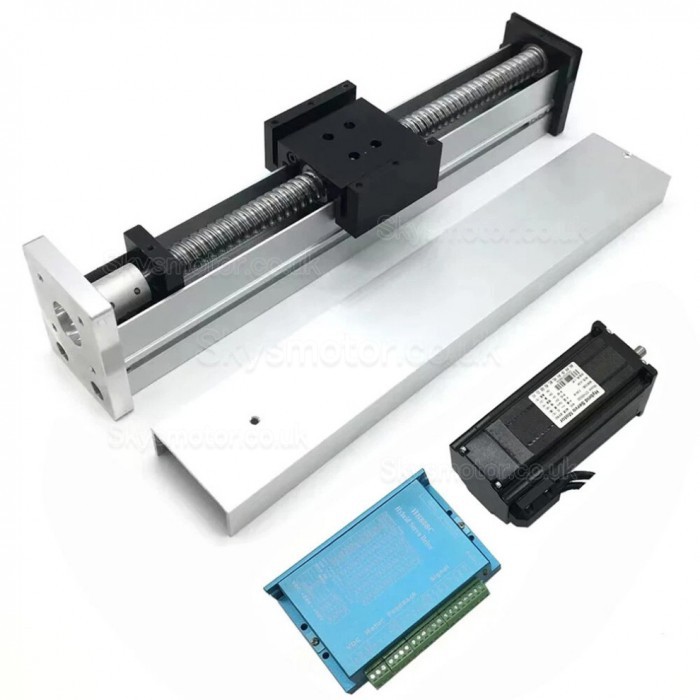
Picture from: QMF40
2. Ball Screw Drive Mechanism
Ball screw drives are designed to improve mechanical efficiency and positioning performance.
Unlike conventional lead screws, ball screws use recirculating ball bearings between the screw shaft and nut. These rolling elements significantly reduce friction during movement, allowing the mechanism to transmit motion more efficiently.
This design offers several benefits, including high load capacity, smooth movement, reduced wear, and good positioning repeatability. Ball screw mechanisms are particularly suitable for applications that require frequent movement, controlled acceleration, and relatively high mechanical loads.
Another important characteristic is their ability to support precise motion control when combined with suitable motors, encoders, and control systems.
Nevertheless, ball screw assemblies typically have a more complex structure and higher manufacturing costs than standard lead screws. They may also require regular lubrication and careful maintenance.
Ball screw-driven motorized linear stages are widely used in CNC machinery, semiconductor manufacturing equipment, precision inspection systems, and industrial automation.
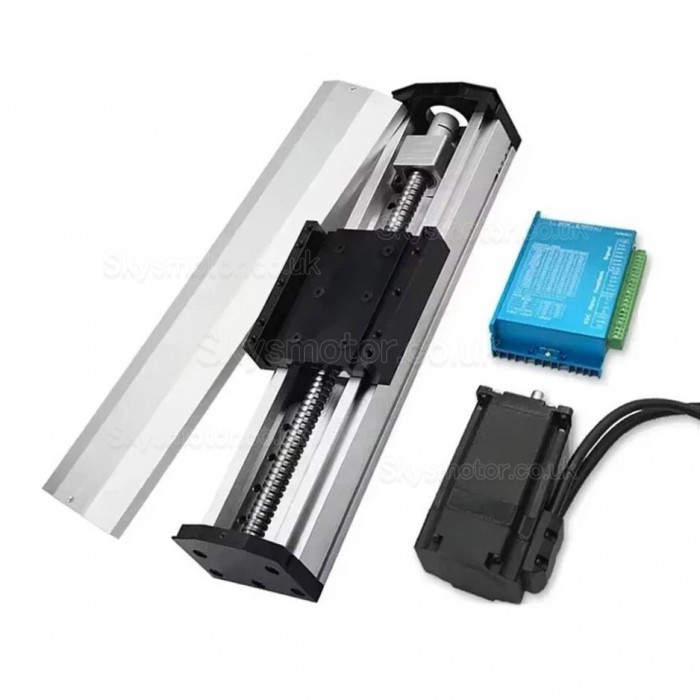
Picture from: OSP001614
3. Belt Drive Mechanism
Belt-driven linear stages use a motor-driven pulley and a tensioned belt to produce linear movement.
When the motor rotates the pulley, the belt travels along the stage and moves the connected carriage. This transmission method is especially useful when long travel distances and high operating speeds are required.
Compared with screw-driven mechanisms, belt drives can offer faster movement, lower moving mass, and relatively simple mechanical construction. They are also suitable for applications where a long stroke would make a screw-driven solution expensive or mechanically challenging.
However, belt elasticity, tension variations, and mechanical wear can influence positioning accuracy and repeatability. For this reason, belt-driven stages may not be the first choice for applications requiring extremely precise positioning.
Typical applications include packaging machinery, material handling systems, automated assembly lines, and high-speed inspection equipment.
4. Linear Motor Drive Mechanism
Linear motors provide direct electromagnetic motion without requiring conventional mechanical transmission components such as screws, belts, or gears.
Their operating principle is similar to that of rotary motors, except that the electromagnetic structure is arranged to generate linear force rather than rotational torque.
Because the motor drives the moving platform directly, linear motor stages eliminate many mechanical transmission-related limitations, including screw backlash and belt elasticity.
This direct-drive architecture enables high acceleration, high travel speeds, smooth motion, and excellent dynamic performance. With an appropriate position feedback system, linear motor stages can also achieve outstanding positioning accuracy and repeatability.
However, linear motor systems generally require more sophisticated motion controllers and feedback devices. Their initial cost and integration complexity may also be higher than those of conventional drive mechanisms.
They are commonly used in semiconductor equipment, advanced optical positioning systems, precision laser processing, and high-speed automated manufacturing.
How Do You Choose the Right Drive Mechanism?
Selecting a suitable drive mechanism requires more than comparing positioning accuracy or maximum speed. Engineers should consider the complete operating requirements of the application.
For example, lead screw drives are often suitable for economical positioning systems with moderate performance requirements. Ball screws offer a practical solution when higher mechanical efficiency and load capacity are needed. Belt drives are attractive for long-stroke, high-speed movement, while linear motors are particularly useful for demanding dynamic performance. Piezoelectric actuators are better suited to applications requiring extremely fine positioning over relatively short distances.
Other factors should also be considered, including payload, acceleration, travel distance, installation space, environmental conditions, maintenance requirements, and total system cost.
The motor, mechanical structure, position feedback device, and motion controller must also work together to achieve the desired performance.