
Ball Screws vs Trapezoidal Lead Screws in Linear Actuators: Which One Should You Choose?
Ball Screws vs Trapezoidal Lead Screws in Linear Actuators: Which One Should You Choose?
How Ball Screws Work
A ball screw uses recirculating steel balls between the screw shaft and the nut. Instead of sliding directly against each other, the contacting surfaces move through a rolling mechanism.
This design substantially reduces friction, allowing the actuator to transfer more of the motor's energy into useful linear motion.
Ball screws are particularly suitable for applications requiring frequent movement, high efficiency, or precise positioning. They are commonly found in CNC machines, automated production equipment, semiconductor manufacturing systems, and industrial robotics.
One important advantage is their ability to operate efficiently at relatively high speeds. However, the rolling elements and circulation mechanism introduce additional complexity, making ball screws generally more expensive than conventional lead screws.
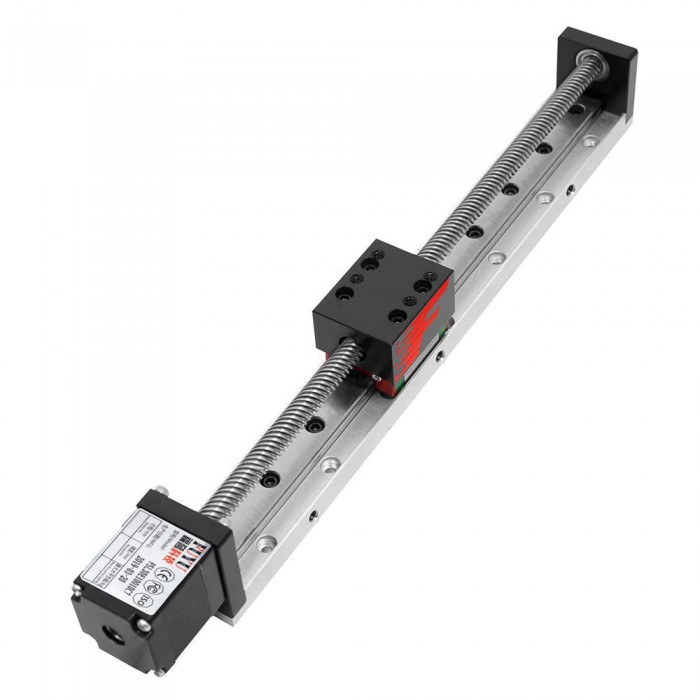
Picture from: FSL30
How Trapezoidal Lead Screws Work
Trapezoidal lead screws feature a threaded shaft with a trapezoidal thread profile. The nut travels along the shaft through sliding contact between the mating threads.
Compared with ball screws, this mechanism is mechanically simpler and often more economical to manufacture.
Trapezoidal lead screws are widely used in lifting equipment, adjustable workstations, positioning mechanisms, and industrial actuators where movement is relatively slow or intermittent.
Their sliding friction creates greater energy losses, but it can also provide useful resistance to reverse motion. In certain configurations, this resistance allows the mechanism to remain in position without continuous motor power.
However, self-locking behavior depends on the thread lead angle, friction conditions, lubrication, and operating environment. It should never be assumed without verification.
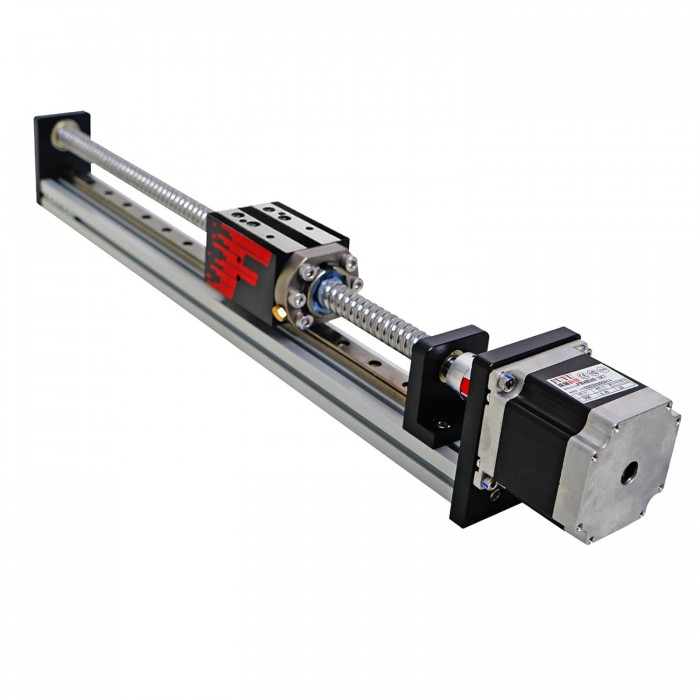
Picture from: FSL40
Efficiency and Power Consumption
Efficiency is one of the most important differences between these two screw technologies.
Ball screws typically achieve mechanical efficiencies of approximately 85% to 95% under suitable operating conditions. Their rolling contact minimizes friction, reducing the torque required to move a given load.
Trapezoidal lead screws generally operate at lower efficiencies, often around 20% to 70%, depending on their geometry, materials, and lubrication.
For an actuator operating continuously throughout the day, this difference can significantly affect energy consumption and motor sizing.
For example, a high-duty-cycle industrial actuator may benefit from a ball screw because its lower friction reduces heat generation and power demand.
On the other hand, a mechanism that adjusts position only a few times per hour may not justify the additional cost of a ball screw.
Positioning Accuracy and Backlash
Both screw types can provide accurate linear positioning when properly designed.
Ball screws are frequently selected for precision applications because they can be manufactured with tight lead accuracy and configured with preloaded nuts to minimize backlash.
This makes them particularly valuable when a system must repeatedly move between precise positions.
Trapezoidal lead screws can also deliver good positioning performance, especially in compact systems operating at moderate speeds.
However, conventional lead screw assemblies may develop increasing backlash as their sliding surfaces wear. Anti-backlash nuts can help compensate for this effect, although they may increase friction and wear.
It is also important to remember that the accuracy of linear actuators depends on more than the screw alone. Motor control, structural stiffness, temperature changes, and assembly tolerances all influence the final positioning result.
Load Capacity and Holding Performance
Ball screws can transmit substantial axial loads while maintaining relatively low operating friction. They are well suited to applications involving repeated motion under load.
However, their high efficiency also means they can be back-driven more easily.
In vertical applications, gravity may cause the load to move when motor power is removed. A brake or other suitable holding mechanism may therefore be necessary.
Trapezoidal lead screws behave differently.
Their higher friction can resist back-driving, making certain designs attractive for lifting and holding applications.
Nevertheless, not every trapezoidal screw is self-locking, and friction alone should not be treated as a safety device when falling loads could cause injury or equipment damage.
The appropriate choice depends on load direction, duty cycle, required holding force, and the consequences of unintended movement.
Durability and Maintenance
Ball screws generally require proper lubrication and protection from contamination. Dust, abrasive particles, and inadequate lubrication can damage the ball circulation system and shorten service life.
In return, their rolling contact can provide excellent durability in demanding applications when correctly sized and maintained.
Trapezoidal lead screws are often easier to maintain because of their simpler construction.
Certain nut materials, including engineered polymers, can reduce lubrication requirements and operate quietly.
However, sliding friction causes gradual wear, particularly under heavy loads or continuous operation.
For both mechanisms, proper alignment, suitable materials, and realistic load calculations are essential for long-term reliability.
Cost and Application Considerations
Initial purchase price often favors trapezoidal lead screws.
Their straightforward design makes them attractive for cost-sensitive equipment, especially where movement speed and operating frequency are relatively low.
Ball screws typically require a higher initial investment, but their superior efficiency can reduce motor requirements, energy consumption, and heat generation.
For equipment running continuously, these operational advantages may outweigh the higher purchase cost.
Engineers should therefore consider total system cost rather than comparing screw prices alone.
Motor sizing, expected service life, maintenance frequency, operating environment, and replacement costs all deserve attention.